


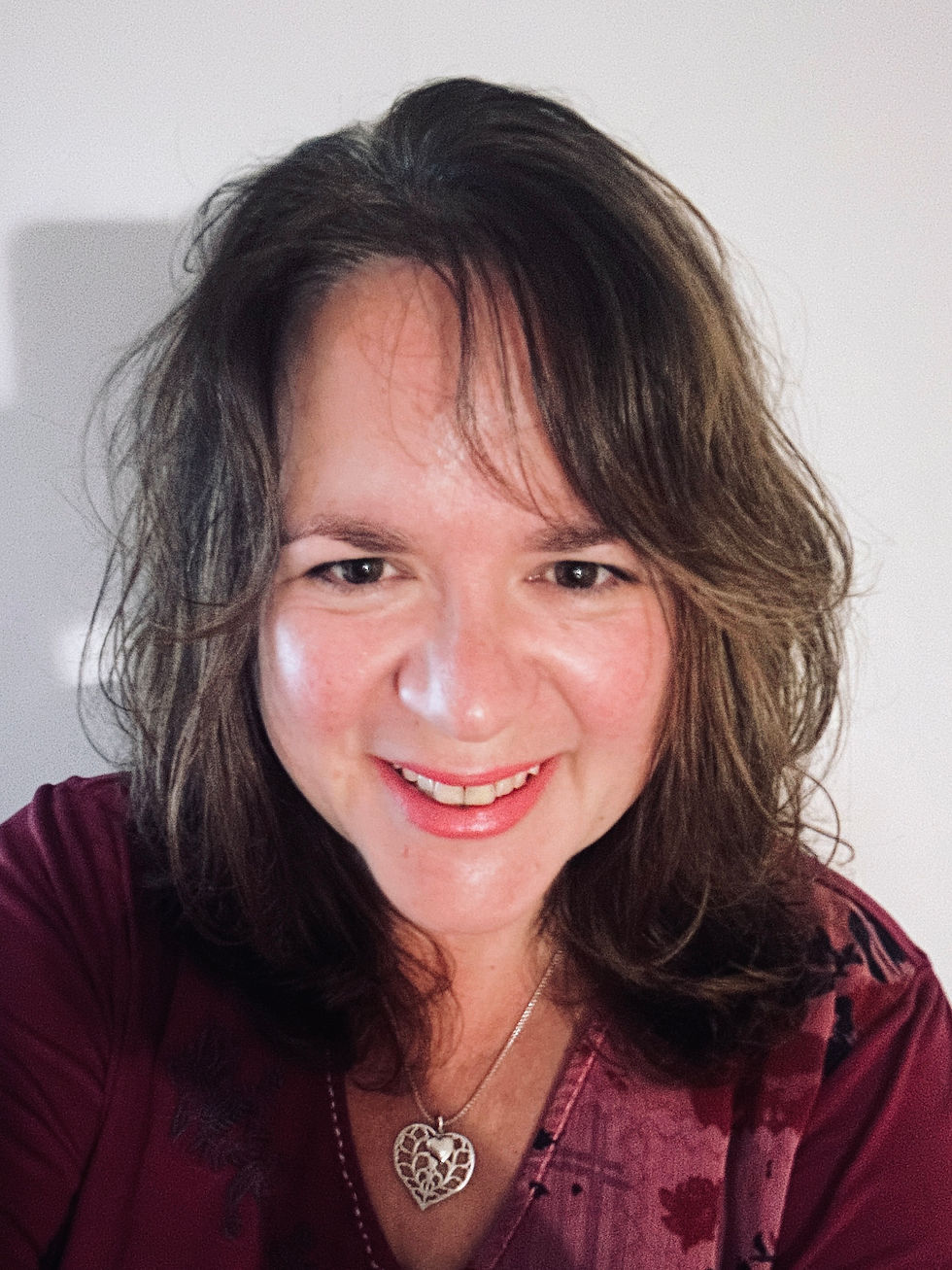
Louise Longson: "In this collection in particular there is definitely a call to recognise our collective responsibility"

A chat with Louise Longson about her poetry collection, The How in the World (Hedgehog Press, 2025)
How would you describe The How in the World in one sentence?
It will be a rambling one, with much punctuation and subordinate clauses. Here goes:
The poems explore the relationship between humans and nature, how we are involved in the natural world, not separate from it; how everything we have done and are doing impacts on our world; how floods, deforestation, wars, pollution are leading to the break of ‘the single thread of spider-silk attached to what is left’ of our disappearing world; they ask you to imagine how you are embodied in the trees, the water, the stones, and how they are in you; they wonder, at the last, how the world might be without you in it.
The cover is stunning – how did the design come about?
I had the last poem in the book, “Graveyard by the Sea” - which uses an image of the poet’s favourite, a hare – in mind. I wanted an image of the hare sitting in a desolated, burning world under a full moon. I used deepai.org to generate some images as I am not great at drawing! Basically, I just kept adjusting the words I put in the search until it came up with two I quite liked.

I have admired fellow-poet Oormila Vijayakrishnan Prahlad’s art for a long time. She produces exquisite work. I thought I would ask if she could paint me a cover, and was honoured that she said yes. A bit of back-and-forth adjusting the images and there is was. It is beautiful, I’m proud to have it as the cover.

How did you come up with the title?
I had written a number of poems exploring themes of oneness with nature and how we shape it and it shapes us. They all had titles that began with “How We Are…” something-or-other. I’m sure I’m not alone in looking at the state of the world today and thinking, “How on earth…?” and it was a short leap to “How in the world has x happened?” As I wrote, I found the titles stood out as a common thread that underpins the implication that the human being is the common factor in the ecological disaster we are facing. The addition of the “The” I feel says, “Look! This, we’ve done this. This is the how that explains what is happening.” Some of the poems are written from the first person (or first being) perspective of trees, birds, the moon etc., so I also wanted something that suggest that we are them as well.
What was the inspiration for the book?
I wanted to move away from the poetry I had been writing that was focussed around individual abuses, losses and griefs and used mythologies and nature as ways of telling those stories, starting from the point-of-view of my personal experiences, and interweaving them with those of other people I’ve met and worked among, thus moving into a more collective grief and mourning that we can all recognise. “The How in the World” is also an examination of abuse, grief and loss applied on a planetary scale. There are so many stories every day about the destruction of habitats through human intervention. I think the thing that really focussed me, though, was a David Attenborough programme that looked at the disappearing habitat of the Kodiak Bear (also known as the Spirit Bear) and something just clicked.

How did you structure the pieces?
In all the books I’ve done, there’s a narrative arch - not of a literal plot-driven story – of emotion. I start, usually, with a statement of the status quo. That might be a literal geographical place, a state-of-the-nation, an emotional place and so on. It then goes up a curve, which explains the “background” to the status quo and builds up to a crux/crisis. Then, it goes on the downward bit of the arch toward some kind of action of restitution/solution (not always a happy one by any means) and ends on what is often the most absolutely fragile sense of hope.
How does form interact with content in the book? For example, a lot of the poems have very short lines, and I wondered if you could talk a bit about why this is?
I want to make maximum impact with brevity! I aim for precision of language and image, so want to pierce straight to the heart of what I am trying to convey. I use white space to create a sense of fragmentation, of distance, breathlessness, exhaustion (for example, in the poem ‘The Impact of Atmospheric Change on Bird Flight.’ I also am not averse to a bit of concrete poetry, as long as the shape adds something to the words, as in ‘How we are like the moon’. I am aiming for immediacy yet creating strata of meaning which allow readers to wander and wonder, and – hopefully – the words will stay with them.
The pieces express a sorrow for what we’ve done to the earth as well as a love for what it has given us – although there are pieces in the ‘I’ voice, it does feel like a book of ‘us’. I wondered whether writing feels like a collective act; whether it helps you to feel closer to people or indeed to the earth?
That’s an interesting one. In practice, I’ve found writing a solitary activity until fairly recently. I know only one poet who lives locally to me, but we both write in our own space, although are supportive of each other’s projects. I’ve been working with fellow-poet Sue Watling on a kind of “call and response” writing thingy, which encourages both of us to wrote something regularly. We meet once a month on Zoom. In terms of the feeling, I think I am conscious that I am not just “writing for me.” I do have a “message” that I want other people to hear, so in that way there is a sense of “us” and in this collection in particular there is definitely a call to recognise our collective responsibility and to realise that it’s through collective action – or at least each individual realising what they do adds to a whole heap of actions – that a) we’ve got to where we are in the first place and b) we can do something about it. I’m not sure about feeling closer to people, to be honest. I’m quite isolated where I am (in a small, very rural village) and by not being able to drive, and not knowing very many “poets in person.” I am a bit of a solitary animal in general, I think, and various historical issues with my mental health has sometimes added to this. I have, though, been running a “salon” online on the last Saturday of each month, and it’s been great getting to know other poets through that. So, it’s a work in progress!
How long did the book take to write?
Ooh, some of the poems have been lurking about in one form or another (usually the form of not-being-very-good) for a couple or three years at least. A version of it was shortlisted in a competition in July 2024 and that version had been fiddled about with since March, so the individual poems will have been started and worked on for quite a while before that. Once I had had the shortlisting (in which it was Commended), I had a very clear idea of what needed to be done and then submitted it to Hedgehog in September 2024, and it was announced as a winner in November 2024. It’s taken a while to get out and about, but I’m glad it’s here now.
Which poets inspire your work?
Oh, lots, so apologies to those I haven’t mentioned. Gillian Clarke, Penelope Shuttle, Ted Hughes, Alice Oswald, Kim Moore, Clare Shaw. Pals in poetry like Wendy Pratt, Lynn Valentine, Ankh Spice, James McConachie – all use language and image so vividly and create beautifully powerful poetry. Morag Anderson, I absolutely love her work, it reduces me to tears of anger and sadness and is just totally viscerally “oof”. I’m inspired by so many of the poets who come to the Last Saturday readings. I love to hear the words, not only see them on the page (iamb.uk is great for this) and hearing a live reading is just dazzling.
What’s your writing process? i.e., do you work at a particular time of day / in a particular place? Do you need silence or can you work in a café?
Silence. Utter sepulchral silence (well, I can hear the birds and windchimes but can zone out even them since we got the new double-glazing). I scribble down any words or ideas on whatever bit of paper is to hand or send myself an email. When I worked from home, I used to do about an hour a day, but now I’m working on site, I don’t do that anymore so I tend to save it all up for Friday, my day off, and one day of the weekend. I will then spend about 4 – 5 hours getting something done. It might not always be writing but reading and research. I do a huge amount of research on a topic or a thing I’m thinking of using as a jumping-off point – Google, Brewer’s Dictionary of Phrase and Fable, Roget’s Thesaurus are my major sources. I love that Thesaurus. I can spend hours going off on tangents. I scribble random things on paper – always use a pencil, never a pen, seldom write on the lines. There’s something for the psychologists! then I type them into a Word doc on my laptop, and something happens, luckily, more often than not. I like to leave poems to steep and mature a bit before I go back to them and edit them like – I was going to say a Fury, but it’s more like the Moirai: measuring, spinning and cutting. Lots of cutting, usually. There’s always something in my head which can take a while to percolate, but I trust it will, now. I travel to work by train through the countryside into are urban area, and I can usually feel the percolation process starting then.
How is the book similar or different to what you’ve written before?
I think as I mentioned earlier, it’s taking the personal grief and loss – so thematically similar – and applying them to the planet. It is still very closely aligned to themes of nature and the environment. Living close to nature in rural England, where agriculture is the dominant way of life still, it’s just part of me, really.
What brought you to poetry and do you write in any other genres?
I led a mental health project called ‘Time to Change’ which was about reducing the stigma associated with mental illness, using various artforms such as painting, drama, dance and poetry as vehicles to start conversations between members of the public and volunteers with lived experience of mental illness. During this, I worked with Oxford Brookes University’s poetry department, led by Eoin Flannery (a wonderful poet), and also came into contact with Deborah Alma, who was then the Emergency Poet, going round in a 1970s ambulance prescribing poetry at various venues and now proprietor of the very successful Poetry Pharmacy book outlets. I really enjoyed the poetry workshops we did, and seeing the therapeutic effect of poetry writing, reading and being read to. During the various lockdowns in the COVID pandemic, I didn’t have to travel to work and had loads of unwonted time on my hands. I saw reports of people learning Japanese, baking sourdough bread, learning to play the saxophone and so on, so thought I should do something productive with this gift of time. I signed on for a free poetry course with one of the initiatives from the Open University and enjoyed it. I then asked Deb Alma to recommend some courses and she suggested Wendy Pratt, who was then running a number of Facebook workshops. did a few of those and felt I wanted to take poetry further and seriously. I asked Wendy to mentor me, and it built from there.
I have had a crack at Flash Fiction, which I quite enjoy and have had a few bits published – I just have another go. And I’d like to get into Creative Non-Fiction as soon as I work out what it really entails.
Have you any readings or other events planned to promote the book?
Yes. I haven’t really had a proper launch yet, as I have been wanting to do it with a couple of other Hedgehog winners but there’s been a hold-up with publications. We are, though, now ready and are going to be launching mine, Margaret Royall’s pamphlet “Hemlock & Honey”, Katrina Moinet’s pamphlet “The Art of Silence” and hopefully Marcelle Newbold & Karen P Gonzalez’s winning Little Black Book as well.
There will be details on
Twitter/X: @LouisePoetical
Bluesky: @louisepoetical.bsky.social
or you can follow all upcoming events on Eventbrite: https://www.eventbrite.co.uk/o/louise-longson-48967317503
Buy the book here: https://witchbottlepoetry.wordpress.com/2025/11/15/the-how-in-the-world/
Link to reviews:
BLURBS:
“How have we have arrived at the end of the first quarter of this century and still not yet seen ecopoetry flower in greater abundance in response to planetary threats that are now horrifying realities? Surely, this is nothing short of a neglect of duty by the global poetry community. With this book, Louise Longson shows us how urgently we need to return to that duty. How our need now is for art that tells the truth about what we've done – what we go on doing – to our one, precious Earth. This is not poetry as eco-preaching. It is poetry that calls our attention to what really matters. It does so with such originality of image, such skilful use of form and language, that it sometimes feels like a lesson from which other poets can (and should) learn.”
Mark Antony Owen, Poet. Author of Subruria. Creator and curator of iamb & After...
“Reminiscent of Alice Oswald, Longson brings a fresh voice to ecopoetry. Drawing attention to the effect of human actions on the shared world where once-living creatures lie unmourned, she warns, do not stand too close to the end of the Earth. This powerful collection asks us not to avert our gaze from the burned earth and wasted blood, but to bear witness and action change.”
Morag Anderson, Poet. Author of And I will make of you a vowel sound (Fly on the Wall Press, 2024)


Comments