


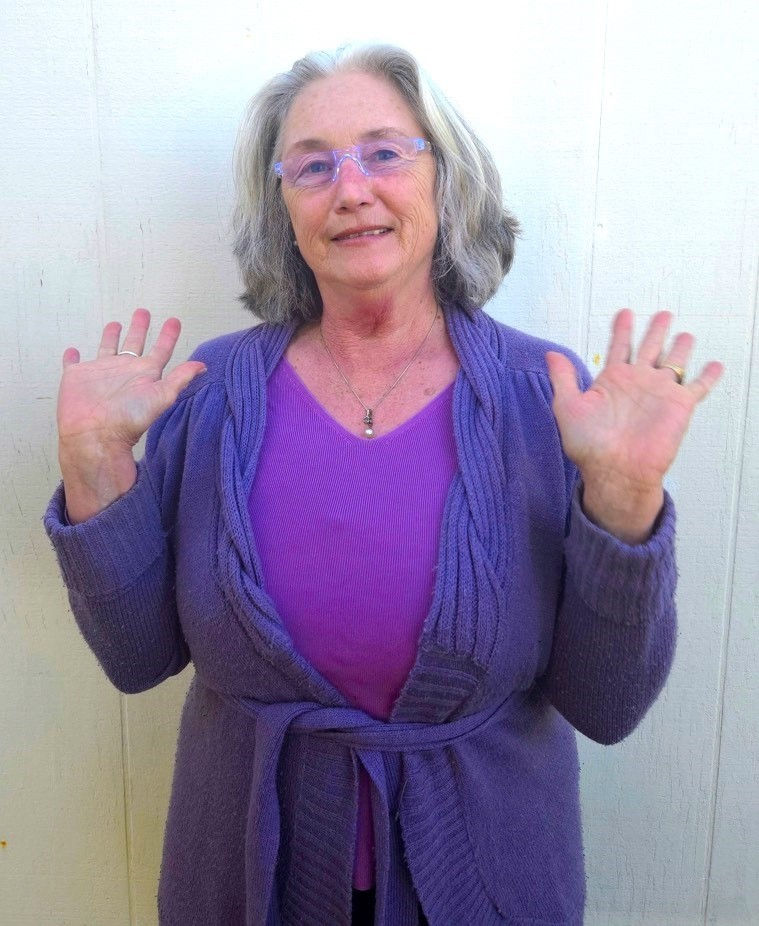
Karen Pierce Gonzalez: "So many moments of everyday life truly are gems unnoticed"

A chat with Karen Pierce Gonzalez about her poetry chapbook, Sun and Moon Wired Together (Bottlecap Press, 2026)
How would you describe Sun and Moon Wired Together in one sentence?
The extraordinarily ordinary of our journeys from day to night.
How did you come to choose Bottlecap as your publisher again?
Originally this manuscript was quickly accepted by one publisher, only to be accepted the following day by Bottlecap. As I had already agreed to go with the first publisher, I had to decline Bottlecap’s offer. When the first publisher decided it was no longer feasible to produce books (print or digital) she rescinded the contract and there I was!
I left the ms alone for a few months then decided it was time to see if I could find a new home for it. Because I had offered Bottlecap the hybrid Moon kissed, Earth wrought, Vision drunk, an equally strong collection with original art in lieu of Sun and Moon Wired Together that they published, I did not know how they would respond to another submission.
So, I took a chance and returned to Bottlecap with Sun and Moon Wired Together. In a week, we had a contract and off we went!
I want to add here that it’s important to establish professional yet personal relationships with publishers and editors, which I did with Bottlecap, because this is what remains even when a project does not reach conclusion.

How did you come up with the title?
The title is an image in the final poem that drove that poem and served to inform the entire collection as well
What was the inspiration for the book?
So many moments of everyday life truly are gems unnoticed. Facets of beauty and wonder, slivers of sorrow, and powerful longings hold us together individually and collectively. These are the glues that bind us.
There’s a lovely sense of progression from morning to night in the book (as well as a fantastic sense of place) all conveyed very imagistically but also very sparingly. I wonder whether you feel poetry, with its large amounts of white space, lends itself to reflections on temporality?
Another profound question, Sam. One I wish I could answer with a simple yes. But truthfully, the poems do a great deal of heavy lifting in the space they occupy on the page without my need to expand or expound. Words placed lyrically to serve one another can carry an image (can journey us) through a metaphor’s evolutionary process.
Having learned, via practice and experience, to trust what arises, I know I can lean into poetry. I can follow the threads and let them weave themselves.
I will say, however, that space in a poem allows it to bloom in a way that provides readers with ‘time’ to have their own experiences. For example, they can see the shade of blue that speaks specifically to them. Too many words, too rushed, can disallow such personal opportunities.
Although there are pieces in the ‘I’ voice I often feel, reading your work, that poetry (and perhaps also art) is where you go to reflect on the world around you rather than your place in it; that you’re more interested in writing about others than about yourself. I wonder if that rings true?
Ah, if only we could draw distinct lines between us and others, between our day and that of a maple tree or a dreamscape! In other words, we are always in relationship to these ‘elements’ and all can serve as mirrors, can’t they?
So instead of paying attention to me, I am free to focus on what catches my attention for that is what inspires me to say something. And this leads to everything else because, I mean everything, is layered with both translucency and complexity. Anything can be the starting point of both inner and outer awarenesses.
Note: An image or story or artwork captures only a moment in the full spectrum of its ‘life flow’’ which I believe never really ends.
You’re an artist as well as a writer. I wonder what inspires you to create a piece of art versus what inspires you to write about it? Do some subjects lend themselves more to one or the other?
Verbal and visual offer different lenses. And I love working in both. During conception, I rarely work on both the visual and verbal components of related content simultaneously. This would limit my ability to completely focus on either one. Instead, one happens first and then the other, although there are times when they are standalone conversations I am having.
But which comes first, the chicken or the egg? I suppose for me, again, I accept that the creative process is an ongoing stream, and today’s poem might be tomorrow’s sculpture or yesterday’s assemblage art may widen my linguistic ability to say something later that was inspired/encouraged by working with specific physical materials.
I will say, though, that when writing a poem or work of fiction, I make sure to honor the visual possibilities of the words so that the reader can feel, hear, smell, and taste alongside me.
With art, I rely upon texture and the interaction between myself and the elements, such as bark, fibers, and colors to provide landscapes that are easy to transverse without words.
How long did this book take to write?
Here’s how I work: I write, write, write poems in cycles. Maybe one cycle is haibun, another narrative, another mythic, and so on. I have no endgame in mind, other than to explore to the best of my ability what inspires me.
Then, after a while I may discover a pattern emerging and so a collection is born. And yes, I do sometimes find gaps where literary bridges need to be built.
In this case, the pattern was, ironically the flow of a day and a night anywhere in anyone’s life. Who knew it would come together like this? I didn’t until ALL OF THE PIECES existed separately.
You’re incredibly prolific – I think you have had at least three books out in the last year? Is there a secret that you can share about getting so much work published? What do you think appeals to people about your work in particular?
Yes, three book and four poetic librettos (little books comprised of 16 pages of art and poetry, published by Four Feathers Press). I have also been creating performance poetry pieces out of several of my already published works as well as a few that may never be published (as they are to be spoken, not read).
My Secret? To keep creating work because that is where the joy is. I understand that anything more than this is simply out of my control; I do not decide the timing of when or if a book is published.
I do have a decent track record. If a piece (collection, single poem, or image) is unaccepted 2 or 3 times, I let it rest. No need to push the tide. I always have other projects to work on. So, I may be more relaxed than others about the process. I know that there are creations that may never see the publishing light of day and that others are important fodder for what will come next. And so on…
I believe the primary appeal of my work is four-fold: the language is easy (no need for dictionary or college degree), the pacing is naturally fluid, the emotive qualities are clear, and the work is created to share not ‘educate’ or ‘enlighten’ others.
Above and beyond that, I trust the reader (and viewer) to be able to draw his or her own conclusions about what I create.
Similarly, imagine there’s a writer starting out who asks you for advice on becoming a poet: what’s the one suggestion you would give / wish you had received yourself?
My suggestion: Write because you love giving voice (spoken or written) to what you think, feel, hear, see, and smell because with these you are orchestrating a symphony of images that organically can be so much more than their individual parts.
Advice I wish I had received: Enjoy, enjoy, enjoy the process. Let things develop, unfold. Give the work (and myself) room to grow. This is what fuels the passion and provides the greatest joy possible.
Have you any readings or other events planned to promote the book?
I am scheduling a few zoom events and plan to use Sun and Moon Wired Together in upcoming poetry performance workshops. The book was released shortly after I was invited to be a feature artist for a special summer show in the Cloverdale Arts Alliance gallery (Northern California). So …
I am straddling promotional opportunities for the book while also creating two art installations, one of which is an exhibit of 3 five-foot tall fiber sculptures based upon the Babylonian women I write about in Moon kissed, Earth wrought, Vision drunk.
Here is a peek at Shamat, the Lover.


Buy Sun and Moon Wired Together (ISBN 978-1-969492-52-5) as print ($10+shipping, USA/Canada) or digital ($3.50 everywhere) from https://bottlecap.press/products/sunakpg
For those interested in what I am doing, please consider subscribing to my brief, monthly enewsletter. Email me at kpgfolkheart@gmail.com or visit linktr.ee/KPGFolkHeart


Comments